Introduction
In 1960, Cuba was the earliest country in Latin America to recognize and establish diplomatic relations with the Democratic Republic of Vietnam (DRV). Over 65 years, the Vietnam-Cuba relationship has represented an enduring model of socialist internationalism, characterized by political trust, ideological affinity, and sustained material cooperation. More than a convergence of political systems, this partnership has been anchored in a profound sense of revolutionary solidarity and shared historical experience. During Vietnam’s protracted struggle against the US, Cuba consistently expressed diplomatic, moral, and material support for Hanoi. Conversely, in the post-Cold War era, as Cuba confronted mounting economic constraints, most notably those associated with the long-standing US. embargo, Vietnam emerged as an important partner in both political advocacy and developmental exchange. Having initiated its Đổi Mới reforms in 1986 and progressively constructed a “socialist-oriented market economy,” Vietnam accumulated practical and theoretical experience in economic transformation that has informed dialogue with Cuban policymakers. Recent years, amid Cuba’s deepening socio-economic difficulties, Vietnam has reaffirmed its solidarity at both the state level and societal mobilization, underscoring the symbolic and substantive depth of bilateral ties.
Despite the historical and contemporary significance of this relationship, scholarly inquiry remains comparatively limited. Existing literature often adopts a descriptive or commemorative tone, or narrows its analytical focus to comparative reforms between Cuba, Vietnam, and China. Such approaches, while valuable, tend to overlook the broader evolution of political trust, strategic adaptation, and reciprocal support that has defined the relationship across distinct historical conjunctures. The relative paucity of comprehensive, document-based studies thus highlights the need for a more systematic and critically grounded examination. Drawing upon original communist party and state documents of Vietnam, diplomatic records, and related archival materials, this article seeks to reassess the Vietnam-Cuba relationship as a dynamic and historically contingent process. It traces the trajectory of bilateral cooperation from the era of anti-imperialist resistance to the contemporary phase of socialist-oriented nation-building. The study also elucidates how patterns of assistance and leadership have shifted over time, from Cuba’s prominent support during Vietnam’s wartime struggles to Vietnam’s increasing role as a partner in economic reform and development dialogue, while demonstrating the persistence of core principles of solidarity, mutual respect, and fraternal cooperation that continue to define this distinctive partnership.
Cuba’s support for Vietnam in the resistance war against the US
The origins of the Vietnam-Cuba relationship are inseparable from the geopolitical and ideological transformations that followed the 1959 Cuban Revolution. Having asserted its independence from US’ influence and embraced socialist internationalism, Cuba sought to align itself with anti-imperialist movements worldwide. In this context, the struggle of Vietnam resonated strongly with Havana’s revolutionary leadership. On 2/12/1960 Cuba and the DRV established ambassador-level diplomatic relation [Central Party Office Archives, 2020, p. 5], a move that carried both symbolic defiance and strategic intent within the Cold War order. The subsequent exchange of ambassadors in 1961-1962 institutionalized bilateral ties and laid the groundwork for sustained cooperation. Cuba’s acknowledgment of the National Liberation Front of South Vietnam in 1965 and of the Provisional Revolutionary Government of the Republic of South Vietnam in 1969 demonstrated an expansive conception of revolutionary legitimacy. These early diplomatic initiatives were reinforced by the Vietnam-Cuba Friendship Association, founded in 1965, which mobilized public solidarity and embedded bilateral relations within broader societal networks. This formative period illustrates that Vietnam-Cuba ties were not merely conventional state relations but a consciously constructed transcontinental alliance grounded in shared ideology, anti-imperialist commitment, and institutionalized solidarity.
The strength of this relation was expressed in both official diplomacy, sustained political and societal engagement. Che Guevara personally received Vietnamese delegations in Havana, underscoring that solidarity with Vietnam was integral to Cuba’s revolutionary identity. Equally pivotal was Melba Hernandez Rodriguez del Rey, who helped institutionalize solidarity by founding the Cuban Committee for Solidarity with Vietnam in 1963. The Committee brought together organizations, intellectuals, and professional associations, transforming support for Vietnam into coordinated political mobilization.
Cuba’s policy toward Vietnam during the 1960s reflected a consistent and operationalized commitment to revolutionary solidarity. This orientation was articulated most explicitly by Fidel Castro in 1966, where he declared that “for Vietnam, Cuba is willing to sacrifice its own blood” [Ruvislei, 2023, p. 24]. The statement encapsulated Havana’s conception of internationalism as entailing not only political endorsement but also concrete sacrifice in the broader anti-imperialist struggle. In July 1966, six Cuban officers were killed during a reconnaissance mission in Vietnam as a result of the US’ airstrike, underscoring the risks Cuba was prepared to assume. Simultaneously, Cuba dispatched medical personnel, engineers, and construction workers to Vietnam, thereby contributing to both wartime resilience and infrastructural development.
Commander Castro’s visit in 1973 is considered a significant event among the visits of foreign leaders to Vietnam. This marked the first and only time a high-ranking foreign leader crossed the 17<sup>th</sup> parallel to reach Quang Tri in South Vietnam. Castro received a warm welcome at the airport from several prominent Vietnamese officials, including First Secretary Le Duan, Chairman of the National Assembly Standing Committee Truong Chinh, Prime Minister Pham Van Dong, and General Vo Nguyen Giap. Additionally, President Ton Duc Thang extended greetings to Castro at the Government Guest House.
Defence cooperation constituted a significant institutional dimension of Vietnam-Cuba relations during the war years. Vietnam established a defence attaché office in Cuba in 1964, and Cuba reciprocated by opening a military attaché office in Vietnam in 1966, thereby formalizing channels of military coordination. During his visit to Vietnam in 1966, President Osvaldo Dorticós declared that “the Cuban people stand ready to fight alongside the Vietnamese people and are prepared to dispatch volunteer combatants at the request of the Government of the DRV” [Ruvislei, 2023, p. 33-34]. Although precise figures remain unavailable, it is clear that Cuban personnel supported Vietnam through medical teams treating the wounded (such as a medical delegation comprising 6 surgeons, 3 anesthesiologists, and 6 nurses in 1972 [Ruvislei, 2023, p. 57]) and maritime crews delivering aid despite US blockades and the bombardment of Vietnamese ports. Especially, Cuba dispatched officers and technical experts, together with equipment, to assist in the construction and maintenance of the Ho Chi Minh Trail, a strategic logistical artery of the resistance. Although Cuban military assistance did not match that of the Soviet Union or China in scale, its political and symbolic significance was nonetheless substantial. Cuban participation reflected a willingness to assume operational risks and to translate ideological solidarity into practical engagement [Dang and Le, 2020, p. 22-23].
An important dimension of cooperation was Cuba’s systematic institutionalization of Vietnam-oriented research and propaganda activities. Approximately 25,000 specialized units were reportedly mobilized to study and disseminate knowledge about Vietnam, including the compilation of popular histories, academic research, Vietnamese literature and periodicals, and the translation of works by Vietnamese leaders and writers into Spanish. Literary, artistic, and cinematic initiatives centered on Vietnam were widely organized, and mass rallies in support of Vietnam’s resistance against the US were regularly convened across Cuba [Nguyen, 1982, p. 69]. Havana established a dedicated radio channel to rebroadcast the Voice of Vietnam, thereby amplifying information about developments on the battlefield and framing US actions within a broader anti-imperialist discourse.
Cuba has provided significant economic support to Vietnam, in the context of the shortages faced by Vietnam. Two countries signed a trade agreement in 1960, followed by protocols on the exchange of goods in 1961, 1964, 1968, and 1969, as well as an agreement on delivery terms in 1965 [Central Party Office Archives, 2020, p. 7, 13, 70, 74, 121, 127]. In addition to bilateral trade, Vietnam requested that Cuba provide a specified volume of aid, while also undertaking technology transfer and supporting the development of infrastructure to promote economic growth, especially the provision of sugar which played a pivotal role in Cuba’s efforts to support socialist nations [Radoslav, 2021]. In 1972, despite the US’ bombing campaign in North Vietnam, Cuba dispatched two ships, Imias and El Jigue, carrying 20,000 tons of sugar to Hai Phong [Ruvislei, 2023, p. 40]. From 1961 to 1979, Cuba supplied Vietnam with 50,000 tons of sugar annually, while also training over 1,000 students and professionals across various fields, and hosting thousands of interns in diverse occupations [Nguyen, 1982, p. 70; Ruvislei, 2023, p. 83].
Cuba also deployed a number of experts to Vietnam in support of development. In 1970-1971, 37 Cuban specialists assisted in Vietnam’s agricultural development, while Hanoi reciprocally sent 71 trainees to Havana for advanced technical training [Central Party Office Archives, 2020, p. 171-173]. More than 1,000 Vietnamese students pursued their studies in Cuba from 1965 to 1975 [Ngo, 2024]. After the 1973 Paris Agreement, Cuba reoriented its solidarity with Vietnam toward large-scale reconstruction, thereby translating wartime support into long-term developmental engagement. Technical teams supplied machinery and assisted to establish cattle farms, while Cuban institutions received Vietnamese trainees to study poultry and livestock production techniques [National Archives Centre III, 1973, p. 8-13]. Additional assistance included support for a steel-mesh cement shipbuilding factory, the delivery of 2 fishing vessels, 1,350 breeding cows, 65,000 fertilized eggs, and 225 purebred pigs, and the construction of 2 noodle-processing factories, 4 coastal broadcasting stations, and 4 meteorological stations [Nguyen, 1982, p. 70].
Trade constituted a central pillar of Vietnam-Cuba cooperation, functioning as both an economic lifeline and a material expression of solidarity. In 1961, Cuba supplied 500 tons of cotton, 200 tons of tobacco leaves, and 5,000 tons of sugar to Vietnam. Vietnam exported 20,000 tons of coal, 5,000 tons of rice, agricultural machinery valued at approximately £40,000, and other commodities [National Archives Centre III, 1961, p. 17-19]. By 1964, Cuban exports to Vietnam had expanded significantly, with sugar shipments doubling to 10,000 tons and other goods, primarily pharmaceuticals, reaching 127,000 tons. Vietnam exported 63,000 tons of coal, 3,500 sets of handicrafts, and 180,000 buttons [Central Party Office Archives, 2020, p. 72-73]. The range of Vietnamese exports broadened markedly: from 12 categories in 1967 to 17 in 1971 and 30 by 1978 [Ibid, p. 123, 129, 205, 269-270]. Although coal and rice, each around 20,000 tons annually, remained Vietnam’s principal exports, the diversification of traded goods indicates a progressively institutionalized and adaptive exchange mechanism.
After 1975, relations between Vietnam and Cuba entered a new phase centered on postwar reconstruction and the consolidation of socialist development. This transition was institutionally anchored in the 1982 Treaty of Friendship and Cooperation, which formalized long-term collaboration on the basis of equality, mutual benefit, and shared ideological orientation. The treaty marked a strategic recalibration in Vietnam’s external relations, from wartime reliance on emergency assistance toward structured, reciprocal cooperation, while reaffirming the comprehensive partnership between the two Communist Parties and the broader solidarity between their states and societies [Nguyen, 2012]. The Military Cooperation Agreement signed in 1984 further deepened bilateral ties. Its provisions included regular exchanges of military delegations, enabling Vietnamese officials to study Cuban wartime experience and facilitating the deployment of Vietnamese experts to assist Cuba [Dang and Le, 2020, p. 23]. Vietnam became a principal beneficiary of Cuban financial and technical assistance, and Cuba’s foremost partner in Asia, as evidenced by frequent high-level exchanges and sustained cooperation in healthcare and agriculture [Haggerty et al., 1990, p. 12-13]. Cuba committed resources to 5 major projects and completed in the 1980s: the Thắng Lợi Hotel in Hanoi (USD 80 million), the 500-bed Vietnam-Cuba Friendship Hospital in Quang Binh, 10 dairy farms in Son La with roughly 1,200 cattle, a poultry breeding farm in Hoa Binh, and the 42-kilometre Xuan Mai-Son Tay road [Haggerty et al., 1990, p. 13; Ruvislei, 2023, p. 70]. Cuba contributed to agricultural modernization through the provision of breeding cattle and Yorkshire pigs, the dispatch of veterinary and husbandry experts, and the training of Vietnamese personnel. These developments show that after 1975, bilateral solidarity was not diminished but transformed into a structured, multidimensional partnership suited to peacetime development and socialist state-building.
During the Cold War, Cuba emerged as a uniquely close ally and ideological partner of Vietnam. Although it lacked the capacity to provide military assistance on the scale of the Soviet Union or China, its consistent moral and political support fostered a distinctive bilateral bond. Despite the constraints of the US embargo, Cuba continued to extend material aid, support cadre training, and assist in infrastructure development for both Vietnam’s wartime and postwar needs. Conversely, Vietnam has affirmed its role as “a close brother and comrade-in-arms, sharing the same trench and common ideals with the Cuban people” [Central Party Office Archives, 2020, p. 66]. President Ho Chi Minh also affirmed that although “Vietnam and Cuba are separated by vast geographical distance, the peoples of the two countries are as close as members of one family” [Ho, 2011, p. 179]. These statements laid an important foundation for the enduring and cooperative relationship between the two countries in subsequent years. Vietnam-Cuba relations during the Cold War can be understood as a paradigmatic case of ideological solidarity among Third World states pursuing socialist trajectories. More than rhetorical alignment, this relationship reflected a substantive convergence grounded in communism and a shared resistance to imperialism, thereby exemplifying the practical and normative dimensions of socialist internationalism.
Vietnam-Cuba friendship after the Cold War
After 1991 the bilateral relationship has evolved, characterised by mutual support in national development and socio-economic advancement while upholding a commitment to solidarity. Vietnam has undergone nearly 4 decades of economic reform and modernisation, achieving notable progress. In contrast, Cuba remains hampered by the enduring impacts of the US embargo, which has stymied its economic restructuring and innovation. Therefore, the dynamic of their partnership has shifted; Cuba finds itself in a state of crisis and increasingly relies on Vietnam’s expertise and support in nation-building and socio-economic development strategies.
The strength of the political relation is evidenced by the frequency of official visits from senior leaders of both nations and by the ongoing collaboration between their respective Communist Parties. A detailed statistical table can be referenced to illustrate the prevalence of high-level meetings between the two countries.
Table 1. (here)
High-level diplomatic exchanges reveal a discernible shift in the directional pattern of visits, shaped by changing historical and structural conditions. Prior to 1986, visits by senior leaders from Cuba to Vietnam were particularly prominent, reflecting Cuba’s active engagement during Vietnam’s wartime and reconstruction phases. This period has been characterized by sustained and often intensified visits by Vietnamese leaders to Cuba. Multiple senior Vietnamese officials traveled to Cuba, and certain leaders undertook repeated visits, indicating not episodic diplomacy but institutionalized political commitment. The consistent participation of Vietnam’s highest officeholders, including General Secretary of the Communist Party, President, Prime Minister, and Chair of the National Assembly, underscores the strategic prioritization of bilateral ties. The two countries have issued five joint statements in 1999, 2007, 2018, 2024, and 2025, reflecting the close and enduring ties between their parties, governments, and states [Central Party Office Archives, 2020, p. 411, 604, 618]. The 2018 Joint Statement affirmed that the special friendship and close solidarity constitute a symbol of the era and an invaluable asset of both communist parties and their peoples [Ibid, p. 619]. The 2025 Joint Statement reaffirmed Vietnam’s enduring solidarity with Cuba and its continued commitment to strengthening bilateral unity and comprehensive cooperation [VNA, 2025]. Alongside Laos and Cambodia, Cuba is designated as a “special friendship”, rather than within standard categories such as comprehensive or strategic partnership, underscoring its exceptional priority in Vietnam’s foreign policy. However, this “special friendship” is fundamentally rooted in shared ideology, historical experience, and a spirit of international solidarity. As such, its practical value, particularly in areas such as economic, security, defense, and scientific-technological cooperations, cannot be assessed according to the conventional metrics typically applied to Vietnam’s relations with countries such as Russia, China, or the US.
Cooperation between the Communist Party of Vietnam (CPV) and the Communist Party of Cuba (PCC) has increasingly assumed a structured and programmatic character, particularly in the domains of theoretical research and cadre education. A pivotal moment was the first joint theoretical seminar in 2012, which institutionalized structured exchanges on socialist construction under market reform and global integration, moving beyond symbolic solidarity toward policy-oriented dialogue. This engagement holds particular strategic value for Cuba as it navigates cautious economic opening under the constraints of the US embargo, drawing on Vietnam’s experience to balance political continuity with socio-economic adaptation. The planned 7<sup>th</sup> theoretical workshop and 3<sup>rd</sup> scientific seminar in 2026 further reflect efforts to connect historical legacies with contemporary governance challenges. Institutional linkages, spanning party academies, ideological bodies, and policy forums, have since consolidated, positioning party-to-party cooperation as a central pillar of bilateral relations within a broader transnational leftist movement.
Vietnam and Cuba have also consistently demonstrated reciprocal support across a range of international forums and institutional mechanisms. Cuba has backed Vietnam’s election as a non-permanent member of the UN Security Council, while Vietnam has facilitated Cuba’s accession to the Treaty of Amity and Cooperation in 2020 and supported its candidacy for the UN Human Rights Council for the 2021–2023 term [Ngo, 2026]. Vietnam has consistently called on the US to remove Cuba from the list of state sponsors of terrorism, lift the embargo, and advance the normalization of bilateral relations [VNA, 2025; Thu, 2026]. This position became particularly salient during the Trump administration, when the US pursued a policy of strangulation and regime change in Havana. In this context, Vietnam has adopted a calibrated approach, avoiding direct confrontation with the US while consistently opposing unilateral sanctions and supporting dialogue and normalization. Drawing on its reform experience, Vietnam has encouraged Cuba to pursue economic opening and deeper international integration, including engagement with the US to mobilize external resources for development. Collectively, these policies reflect a strategy of hedging: Vietnam sustains its ideologically grounded “special relationship” with Cuba while deepening strategic ties with the US as a key economic partner, underscoring both diplomatic pragmatism and Cuba’s distinctive place in its foreign policy.
Defence cooperation between Vietnam and Cuba has been institutionalized through successive Cooperation Plans (2014-2016 and 2017-2019), prioritizing defence industry development, air defence, military medicine, training, and personnel exchanges. The Information Security Agreement (2017) and the Military Cooperation Agreement (2018) further consolidated the legal and strategic foundations of bilateral engagement. Current cooperation is articulated across 6 principal dimensions: the sharing of Vietnam’s experience in people’s warfare; assistance in strengthening defence zones; support for reorganizing and enhancing the combat readiness of the Cuban armed forces; capacity-building in leadership and command structures; collaboration in doctrinal research and documentation; and the training and professional development of defence personnel [Dang and Le, 2020]. Vietnam has dispatched hundreds of military experts, engineers, and air defence specialists to Cuba, reflecting a shift in the functional balance of the partnership.
This relation is also reinforced by sustained people-to-people solidarity through mechanisms such as the Vietnam-Cuba Friendship Association. This solidarity unfolds against markedly divergent socio-economic trajectories. While Vietnam has advanced comprehensive reform, Cuba has faced persistent structural constraints, exacerbated by the US embargo. Between 1989-1994, Cuba exports declined by 80%, and GDP reduced nearly 50% [Bunck, 1996, p. 236]. Recently, GDP in 2023 was 10.1% lower than in 2018. Structural deterioration is evident in production indices: in 2022, industrial output stood at 46% of its 1989 level, while the sugar sector operated at just 7% capacity. Agricultural output between 2018 and 2022 declined sharply, including rice (-69%), beans (-57%), pork (-90%), and vegetables (-42%), contributing to acute food shortages and an economic downturn [Center for Latin American & Latino Studies, 2023, p. 3]. Vietnam has consistently translated political solidarity with Cuba into material and humanitarian assistance. Forms of support have included rice shipments, educational supplies, clothing, financial contributions, preferential trade arrangements, and cooperation in agricultural projects [Ruvislei, 2023, p. 94]. Vietnam donated around 20,000 tons of rice annually in the 1990s. In 2017, Vietnam cancelled Cuba’s outstanding debt of USD 143.7 million. The “65 Years of Vietnam-Cuba Friendship” campaign (8-10/2025) aimed to mobilize at least VND 65 billion to support Cuba; but within a month, contributions exceeded VND 400 billion. On 1/9/2025, the first installment of USD 15.7 million was delivered to Cuba [Ngoc, 2025].
Although Cuba is not among Vietnam’s principal economic partners, economic relation has expanded since the 1990s. A series of formal agreements were designed to institutionalize economic engagement, including on the Promotion and Protection of Investment (1995), on Trade Exchanges and Other Forms of Economic Cooperation (1996), on Bilateral Tourism Cooperation (1999), on Cooperation in Quarantine and Plant Protection (1999), and on the Avoidance of Double Taxation and Prevention of Tax Evasion with Respect to Income Taxes (2002) [VCCI, 2016, p. 9]. A new trade agreement in 2020 provides for the gradual elimination or reduction of tariffs on bilateral imports within 5 years and further signals a commitment to deepening economic integration despite structural constraints and geographical distance.
In 2000, Vietnam exported goods worth USD 81.8 million to Cuba, of which rice accounted for USD 73.7 million, underscoring the concentration of trade in essential commodities. Cuba’s exports to Vietnam were negligible, amounting to only USD 28.9 thousand in pharmaceuticals [OEC, 2025]. Before 2005, Cuban exports to Vietnam remained under USD 1 million annually. After 2005, it increased slightly to approximately USD 2-3 million yearly, except for 2008, when it fell to USD 712,000 [VCCI, 2016, p. 9]. These figures highlight the structural asymmetry in bilateral trade, characterized by Vietnam’s dominant export position and the limited diversification of Cuban outbound flows.
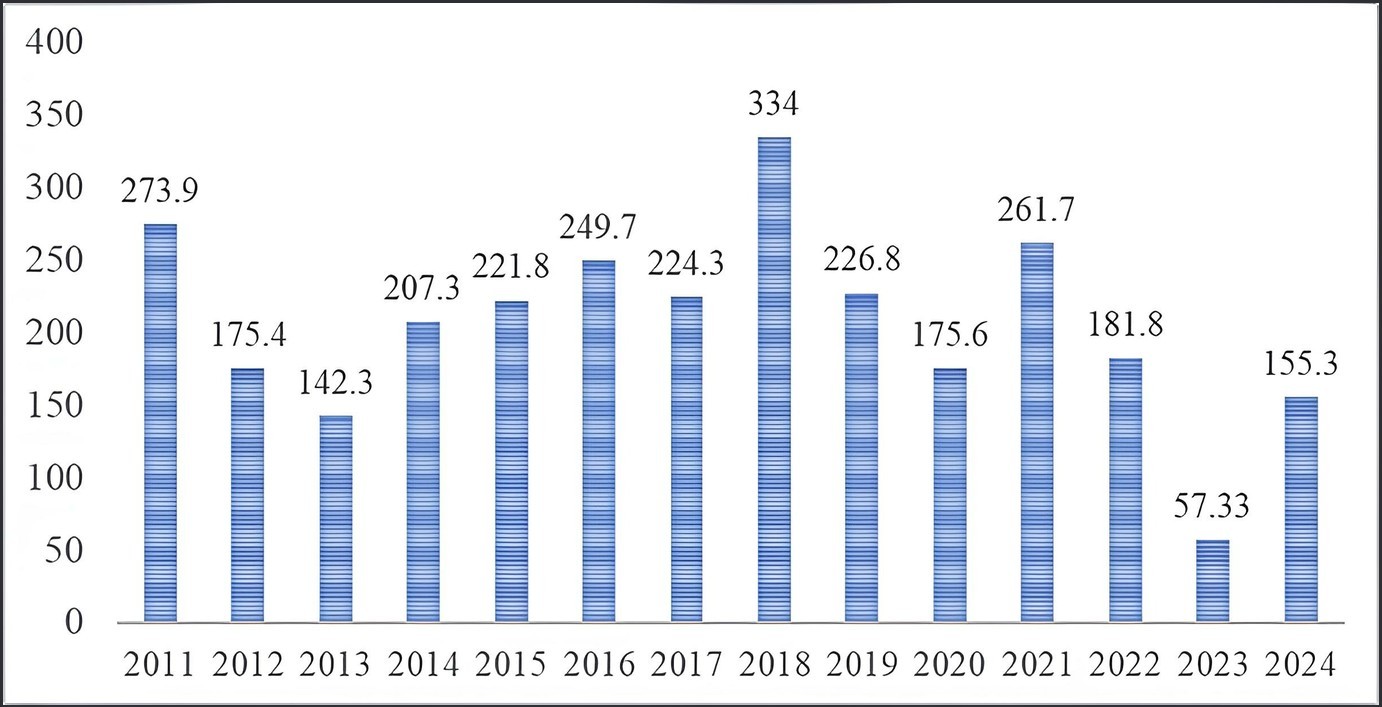
Since 2010, Vietnam has ranked as Cuba’s second-largest trading partner in Asia, reflecting a gradual consolidation of economic ties. Trade reached USD 175.42 million in 2012, and rose to USD 240 million in 2016, placing Vietnam among Cuba’s top ten global trading partners (after Russia and Japan). By 2022, trade reached USD 255 million, with Vietnam exporting USD 219 million (over half consisted of rice), while Cuba exported USD 36 million, primarily pharmaceuticals [OEC, 2025]. Trade flows, however, remain vulnerable to macroeconomic volatility. In 2023, it fell sharply to USD 57.33 million before rebounding to USD 134.7 million in 2024. During a 2025 meeting between Prime Minister Pham Minh Chinh and President Miguel Diaz-Canel Bermudez, two countries set a target of USD 500 million in trade by 2030. Vietnam expressed readiness to expand investment in key sectors, while Cuba pledged to facilitate Vietnamese engagement in agriculture, biotechnology, pharmaceuticals, consumer goods, tourism, and oil [Ha, 2025].
Trade between Vietnam and Cuba remains structurally asymmetrical yet functionally complementary. Cuba imports a broad range of Vietnamese goods, including rice, coal, chemicals, textiles, and consumer products, while exporting primarily pharmaceuticals and biotechnology, reflecting Vietnam’s strengths in agriculture and light industry and Cuba’s comparative advantage in biomedical research. Rice has been central to this exchange; in 2016 and 2017, Cuba ranked 5<sup>th</sup> among Vietnam’s rice export markets, importing 400,067 and 321,474 tons, respectively [Ministry of Industry and Trade, 2018, p. 20]. However, from 2022, Vietnam rice exports to Cuba declined markedly, indicating both market volatility and the impact of Cuba’s domestic economic constraints [VietnamBiz, 2024]. Cuba has expanded exports of biotechnology products and medical equipment to Vietnam. A notable example of deepened health-sector cooperation occurred in 2021, when Vietnam ordered 10 million doses of a Cuban-developed COVID-19 vaccine.
Agricultural cooperation is a strategic pillar of bilateral relations, focused on concessional rice provision and the transfer of technical expertise to strengthen Cuba’s domestic production. Since 2002, five phases of household-scale rice development projects have expanded across multiple provinces, increasing cultivated area from 137,000 to 200,000 hectares and generating around 300,000 tons of output, meeting nearly half of national demand [WTO Center, 2017]. In 2025, Vietnamese-supported projects assisted in harvesting around 1,300 ha of rice in Cuba, with average yields of 6-7 tons/ha, contributing to Cuba’s annual requirement of roughly 600,000 tons. The operations of AGRI VINA have reportedly doubled local rice yields, underscoring the tangible developmental impact of technology transfer and reinforcing agriculture as a cornerstone of economic cooperation.
Bilateral investment remains modest, reflecting structural constraints in both economies despite strong political ties. Cuba’s presence in Vietnam is limited: its first project, Bio Vietnam (1999) in biological pest control, was followed by only one registered investment by 2016, valued at USD 6.6 million and ranking 75<sup>th</sup> among 110 foreign investors [VCCI, 2016, p. 9]. Vietnam’s investment in Cuba, while still constrained, is more substantive, including two oil and gas exploration projects by PetroVietnam Exploration Production Corporation and a broader portfolio of seven projects totaling approximately USD 160 million. Investment has diversified into agriculture, construction materials, fertilisers, pharmaceuticals, solar energy, and oil and gas, with key actors including Thai Binh Corporation, Viglacera Corporation, and Agri VMA [Ha, 2025]. Notably, since 2019, Viglacera has developed the ViMariel Industrial Park within the Mariel Special Development Zone, the first limited-term concession granted to a wholly foreign-owned enterprise in Cuba. Covering 256 hectares, ViMariel has attracted firms across multiple sectors, signaling gradual institutional deepening of investment ties, albeit at a scale still limited relative to the political significance of the relationship [Minh, 2024].
Conclusions
After 65 years of diplomatic engagement, Vietnam-Cuba relations remain defined less by material interdependence than by historical solidarity and ideological affinity. Cuba’s early wartime support established an enduring moral-political foundation that continues to shape bilateral cooperation. In the post-Cold War period, as Cuba has navigated prolonged embargoes and gradual reform, Vietnam has reciprocated through technical assistance, concessional trade, and selective investment. This trajectory indicates that the relationship’s resilience derives primarily from sustained political coordination and societal solidarity rather than economic complementarity, and become a model of a special friendship. Moreover, structural constraints, including limited trade potential, overlapping export profiles, and Vietnam’s earlier dependence on external assistance, have historically circumscribed the depth of commercial ties.