A cognitive-semiotic and pragmatic view of politeness may be considered as a sophisticated cultural code which is used to control the interpersonal equality and balance in society by means of language. The explicit statement of the pragmatic aspect of speech communication has been made in Russian linguistic studies ever since Bogdanov (1990) saw communication as a sociologically mediated process that connects semantic and pragmatic contents [Bogdanov, 1990, p. 87]. Karasik (1991, 2002) continued to develop this scheme further and envisaged politeness as one of the elements within the linguistic representation of social hierarchy and self in discourse [Karasik, 1991; 2002, p. 29-30]. Formanovskaya (1987, 2002) developed a sophisticated theory of Russian speech etiquette based on the notion of a normative standard of communicative behavior aimed at preserving social cohesion and mutual respectiveness [Formanovskaya, 1987; 2002, p.156], and Polivanova (2012) noted the dynamism and situational character of language manifestations of politeness in everyday interpersonal communication [Polivanova, 2012, pp. 21-27].
Larina (2009) developed these points and demonstrated that politeness in Russian and English linguistic cultures is associated with different values, such as collectivist emotional unity and individual freedom. According to Daulet (2019), they were linked to the Chinese philosophy of linguistics and they illustrated that face, or 面子 [miànzi] is a concept of cognition as well as a moral concept which encompasses both the harmony of communication and hierarchy of social status [Daulet, 2019, pp.156-176].
The combination of these perspectives views politeness as a semiotic term of cross-cultural nature, which involves ethical principles, power imbalance, and communicative equilibrium as a dynamic point of convergence between language and thought, social identity, and moral order. Regarding this, the Chinese diplomatic discourse is a rich field of research on the linguistic and ideological aspect of politeness because the place where language, culture and politics meet is diplomacy. The cultural origins of the Chinese politeness are rooted in the Confucian principles of Li (ritual propriety) and He-he (harmony); they are the principles of mutual respect, balance, and reciprocity in social behaviors [Li, 2014, pp. 23 -39; Gu, 1990, pp. 237-257]. The idea of face - 面子 [miànzi] is one of the foundations of the Chinese somatic cultural code [Daulet et al., 2019-1, p. 706], and it is the main Chinese linguocultural conceptual framework of societal norms and communication patterns in modern Chinese society [Daulet, 2019, p. 173]. Together with other closely connected concepts such as the concept of “情” [qíng] and “心”[xīn], it can be seen as a cognitive and emotive foundation of Chinese interaction. Here the inference can be made that face should not be seen as an extra etiquette but as the significant practical resource during the course of conducting the diplomatic communication.
Translation and cross-cultural pragmatics The study suggests that it is not possible to divide politeness with intercultural mediation. Translators in diplomatic environments have to achieve a balance between accuracy and harmony since literal translation can cause semantic loss or pragmatic distortion [Charteris-Black, 2011, pp. 370-372]. Comparative studies (e.g., Kumar and Jha, 2010) show that the features of politeness undergo culture-specific pragmatic transformations in the course of translation, and the mechanisms are adjusted to maintain the balance between people rather than equality in language [Kumar and Jha, 2010, p. 175].
Corpus analysis can prove that the degree of politeness is different both in the degree of intensity and purpose of expression: English values clarity, Russian - a formal distance, and Chinese - empathy and orientation [Li Mingyang, 2020]. Such results indicate the need to form a multidisciplinary linguistic-cultural-translation research network of diplomatic politeness.
The current paper investigates the linguistic expressions of politeness in Chinese diplomatic language by means of lexical, translation-based and perception-oriented analysis to clarify its cultural specificity. It deals with lexical-semantic and pragmatic devices - honorifics, euphemisms, mitigation particles, indirect constructions, and modal combinations - within the framework of official Chinese diplomatic writing, its translations, and shows how these forms contribute to the creation of tone, relational alignment, and intercultural balance.
An individual lexical index was developed that can classify the examples of politeness markers in terms of the operators type, semantic features and context of activation to ensure methodological transparency and the presence of cross-genre representation. The analysis is conducted using the image-information-interpretation model, which defines politeness as a conceptual entity with three interconnected facets, which are, the image, which is the image of the act of communication and the roles played by the participants, the information, which is the manifestation of both semantic and syntactic characteristics, and the interpretive field, which is composed of evaluative and inferential meanings. Since linguistics study of a concept involves more profound insight into spiritual, cultural and social human values [Daulet et al., 2019-2, p. 694], it allows us to disclose the cultural base of politeness as a value-based communicative phenomenon.
Theoretical significance of this research is that it will demonstrate how cultural face, harmony and empathy codes can determine the linguistic aspect of diplomatic communication and its practical value is to offer a repeatable translation training model and intercultural negotiation. Lastly, politeness in Chinese diplomacy is not merely a functional instrument but also a kind of soft power symbolically present in the area of international communications.
Politeness may also be viewed both as a linguistic and a cultural phenomenon since it is situated at the interface between pragmatics, sociolinguistics, and intercultural communication. Politeness in diplomatic speech is not an instrument of etiquette but rather an institution mechanism which controls stance, preserves face in international relationships and aids in adjusting inter-state relationships. As per the goals outlined in the Introduction, in this part we will present the theoretical and cultural frameworks that inform our analysis, i.e. the most important politeness theories and their applications in the field of diplomacy, lexical- semantic embodiment of politeness in Chinese, contrasted to the English and Russian diplomatic registers, and cross-cultural codes, such as, “面子” and “情”, “和合”, which motivate repeated choices in wording, structure, and tone. The Chinese conceptualization of the notion of face is not merely a common psychological concept but a cultural-linguistic code that stands for the communal moral order and coherent communication. Lexical and phraseological systems and their symbolic meanings have a role in determining how politeness is achieved in diplomatic and institutional discourse focusing on the ideas of dignity, restraint, and reciprocity as important social values.
The concept of politeness can also be explained as Brown and Levinson (1987) conceptualizing the reduction of face-threatening acts using techniques that promote positive face (solidarity/approval) or reduce negative face (non-imposition/autonomy) [Brown and Levinson, 1987, pp. 61-65]. The model continues to serve as a reference point in identifying the politeness behaviors (such as deference, hedging, indirectness), but the view is based on the idea of interactional reasoning that emphasizes the agency of individuals. Leech (2014) redefines the notion of politeness in sociopragmatic meanings where the idea of genre, role, and setting dictates the meaning of appropriate mitigation [Leech, 2014, pp. 45-50]. Further, Spencer-Oatey (2008) associates politeness with rapport management, including rights, duties, and face sensitivity during institutional interactions [Spencer-Oatey, 2008, p. 258].
The other theoretical approach is based on the Chinese academic discourse. Gu (1990) proposes a maximalist concept of Chinese politeness grounded on the Confucian virtue of 礼 [lǐ], 人情 [rénqíng]- where respectfulness (敬 [jìng]), modesty (谦 [qiān]), attitudinal warmth (温 [wēn]) and refinement (雅 [yǎ]) motivate cooperation [Gu, 1990, pp. 23-30]. The idea of relational ritual is also supported by Pan and Kadar (2011), who indicate that indirectness in Chinese communication can mean empathy rather than evasion [Pan and Kadar, 2011, pp. 152-158]. All of these approaches converge on one significant aspect of diplomacy, that politeness is not simply an instrument of escaping offense, but a morally loaded activity of establishing harmony and mutual recognition. There is a need to be careful when considering politeness as just any technical tool since it is both discursively negotiated and ideologically situated [Watts, 2003; Eelen, 2001]. Translation in diplomatic settings implies that even an apparently identical expression may alter the pragmatic sense of respect or restraint in languages. Our position on the analysis is in between the two extremes of being entirely one-sided, i.e., the application of the typological model offered by Brown and Levinson to the operations and Chinese models to the cultural logic underlying their application, and the discursive accounts to the aspects of power/ideology specific to state communication.
Based on theoretical aspects that have been addressed earlier, this part is going to consider how diplomatic politeness could be linguistically and pragmatically implemented in real-life discourse. The purpose is to investigate how culturally defined notions of respect, empathy and harmony are realized through the selection of lexical items, syntactic structures and translation strategies in Chinese, English and Russian diplomatic discourse. These mechanisms are demonstrated in context in the examples below and it can be observed how abstract politeness theories are brought to life in authentic texts and how multi-lingual translation makes them inter-personal and institutional effects.
It is important to note that politeness formulae in Chinese diplomatic communication have a different role in formal written documents and in informal negotiation situations. The inability to differentiate between these two types of communication may cause pragmatic over-generalization in translations. Lexically speaking, there are four major mechanisms employed in Chinese diplomacy politeness:
(a) Honorific address and titles – such as in written diplomatic context “阁下” [gèxià]-“Ваше Превосходительство” - “Your Excellency”; And in public oral negotiations “贵国” [guìguó] -“Ваша страна” - “Your esteemed country”; “贵方” [guìfāng] - “Ваша сторона” - “Your side”.
(b) Polite particles and softeners – “请” [qǐng] “please” - “пожалуйста”; “吧 / 呢” [ba / ne] as sentence-final softeners or mitigators that can be used in a limited or context-dependant capacity; 谨 [jǐn] - с уважением - respectfully that is used in writing only.
(c) Euphemistic templates – “有所不同” [yǒu suǒ bù tóng] - “имеются некоторые расхождения” - “different views”; “关切” [guānqiè] - “озабоченность” -“concerns”; “妥善处理” [tuǒshàn chǔlǐ] – “надлежащее урегулирование” - “handle properly”.
(d) Volitional or epistemic modality – “愿” [yuàn] - “выражать готовность” - “be willing”; “希望” [xīwàng] - “надеяться” - “hope”; “将” [jiāng] - “будет/намереваться” - “will” (commitment under protocol control).
At the syntactic level, two key patterns stand out:
[1] Preposed value frames – “在…基础上” [zài … jīchǔ shàng] - “на основе …” - “on the basis of …”; “本着…精神” [běnzhe … jīngshén] - “в духе …” - “in the spirit of …”, which legitimize proposals.
[2] Parallel constructions – “相互尊重、平等互利” [xiānghù zūnzhòng, píngděng hùlì] - “взаимное уважение и равноправное сотрудничество” - “mutual respect and mutual benefit that express symmetry and cooperation.”
In their functional sense, these forms express respect, empathy, and cooperation, even though the tone and explicitness differs, which can be explained by the diplomatic history of each language respectively. This interaction is best seen in formal communiques and press conferences where the three languages are used to affirm cooperation and consideration of all the parties involved but it is more diverse with regard to directness and emotional sensitivity.
To demonstrate how the linguistic resources may be used in context, two examples will be presented below. The first case demonstrates the value-first framing strategy often found in joint announcements, whereas the second case shows the part played by euphemism and mitigation in conflict resolution without disturbing the peace.
Example 1. Joint communiqué frame
CN: 在相互尊重、平等互利的基础上,双方将持续拓展务实合作。1 [Zài xiānghù zūnzhòng, píngděng hùlì de jīchǔ shàng, shuāngfāng jiāng chíxù tuòzhǎn wùshí hézuò].
EN: On the basis of mutual respect and mutual benefit, the two sides will continue to broaden practical cooperation.
RU: Стороны намерены и далее развивать практическое сотрудничество, опираясь на принципы взаимного уважения и взаимной выгоды.
The value-first framing 在彼此尊重、平等互利基础上 [zài bǐ cǐ zūnzhòng, píngděng hùlì de jīchǔ shàng] sets a constructive and harmonious context that reduces the threat to face and makes commitment acceptable. Although in English it would be correct to say that something is done on the basis of, building on the principles of is better in conveying the evaluative and relational aspect. In Russian, a literal “на основе” sounds bureaucratic; the adapted “опираясь на принципы” more naturally reflects value-based diplomacy. The mutual respect structure “相互尊重” [xiānghù zūnzhòng] / “平等互利” [píngděng hùlì] generates relationship symmetry and safeguards group face. The parallelism is maintained in both English and Russian, and re-presents the diplomatic symmetry script, which indicates reciprocity and equality. In the commitment sentence “双方将持续拓展务实合作” [shuāngfāng jiāng chíxù tuòzhǎn wùshí hézuò] Chinese puts the actor after the value prefix, whereas English repeats this sequence: the two sides will continue to broaden working relations. Russian does though put the actor and intention first: Стороны намерены и далее развивать, according to the diplomatic tradition of highlighting the actor and the clarity of its intentions. Lastly, the cluster 将持续拓展 [jiāng chíxù tuòzhǎn] conveys the idea of continuity and commitment. The English equivalent to express the same meaning is will continue to broaden and the Russian one is продолжат развивать, both of which are effective in conveying the sense of forward movement. The best way to translate 务实合作 [wùshí hézuò] is as substantive cooperation or предметное сотрудничество, both of which reflect the result-oriented and active nature of Chinese diplomatic discourse.
Example 2. He-he framing
CN: 我们愿同各方一道,推动地区和平稳定与共同发展。2 [Wǒmen yuàn tóng gèfāng yīdào, tuīdòng dìqū hépíng wěndìng yǔ gòngtóng fāzhǎn.]
EN: We stand ready to work with all parties to advance regional peace, stability and common development.
RU: Мы готовы совместно со всеми партнёрами содействовать укреплению мира, стабильности и общего развития в регионе.
The English language copy is a common form of diplomatic English-clear, neutral and institutional balanced. Stand ready to means that one may be prepared to work without necessarily over-committing and advance means that one may take an active yet non-assertive position, in line with the Anglo-diplomacy concepts of moderation and low-context accuracy.
Russian translation focuses on the inclusive diplomatic formulation, that is, совместно со всеми партнерами, that better represents the collective and non-exclusive nature of the Chinese expression 同各方一道 [tóng gè fāng yí dào]. The reduction of assertiveness is conveyed by the verb содействовать укреплению, and this time, the direct word продвигать (to support) is not used but the term used is facilitating, which is indicative of the consensus and collective agency in Russian foreign policy.
To make a general comment, the English version appears to imply institutional capability and clarity, whereas the Russian version indicates relational harmony and unity. These two examples are illustrations of the way in which translation may alter the politeness levels and agency to meet cultural standards - accuracy and self-discipline in English, and collaboration and team spirit in Russian.
The diplomatic language in China indicates that politeness is a complex process of lexical, pragmatic, and cultural encoding which reflects and at the same time regulates the national sentiment. Nevertheless, even though politeness is a common feature of all communicators, it appears to be highly culturally-specific, namely, being dominated by such culturally-specific values as the Confucian values such as “li” (propriety), “qing” (sympathy), and “he” (harmony) [Gu Yueguo, 1990. pp. 237-257]. The somatic cultural code of face and heart has a major role in the Chinese linguistic worldview and integrates moral, emotional and social meaning elements. These codes have denotative, functional-stylistic, and emotional-expressive meanings which define the communicative behavior and demonstrate respect and empathy in diplomatic discourse. In this part, this section examines the direct and indirect expressions of politeness and their translation into Chinese, English and Russian diplomatic discourse. Indirect politeness in Chinese diplomatic discourse is expressed in clear signs of respect - lexical and syntactic honorifics, titles, and formulaic salutations that explicitly recognize the hierarchical and ceremonial nature of inter-state communication. These forms emphasize the mutual recognition, institutional dignity, and ideology equality [Pan and Kadar, 2011; Brown and Levinson, 1987].
(Table. 1. Lexical and Pragmatic Functions of Direct Politeness in Chinese Diplomatic Discourse)
Politeness Form
The indirect politeness is also the most widespread type of Chinese diplomatic language. It incorporates syntactic mitigation, semantic understatement and context indirection as the modes of persuasion that do not threaten interpersonal equilibrium. It can be viewed as the representation of the Confucian idea of 和而不同, or harmony without uniformity, which allows disagreement but in a polite framework.
(Table. 2. Diplomatic Politeness Translation Triangle)
Corner
Successful diplomatic translation should be built on the equilibrium of semantic accuracy, pragmatic purpose, and cultural resonance as shown in table 2. At its center lies diplomatic politeness, which combines preciseness and relational concern. The role of translators is as strategic mediators who align political, cultural and interpersonal meaning. Tri-Balance Model (Figure 3) sees translation as a dynamic equilibrium between the two- when it is closest to that center, it stays most faithful to the original intent, tone, and ethos.
Fig. 3. Tri-Balance Model of Diplomatic Translation
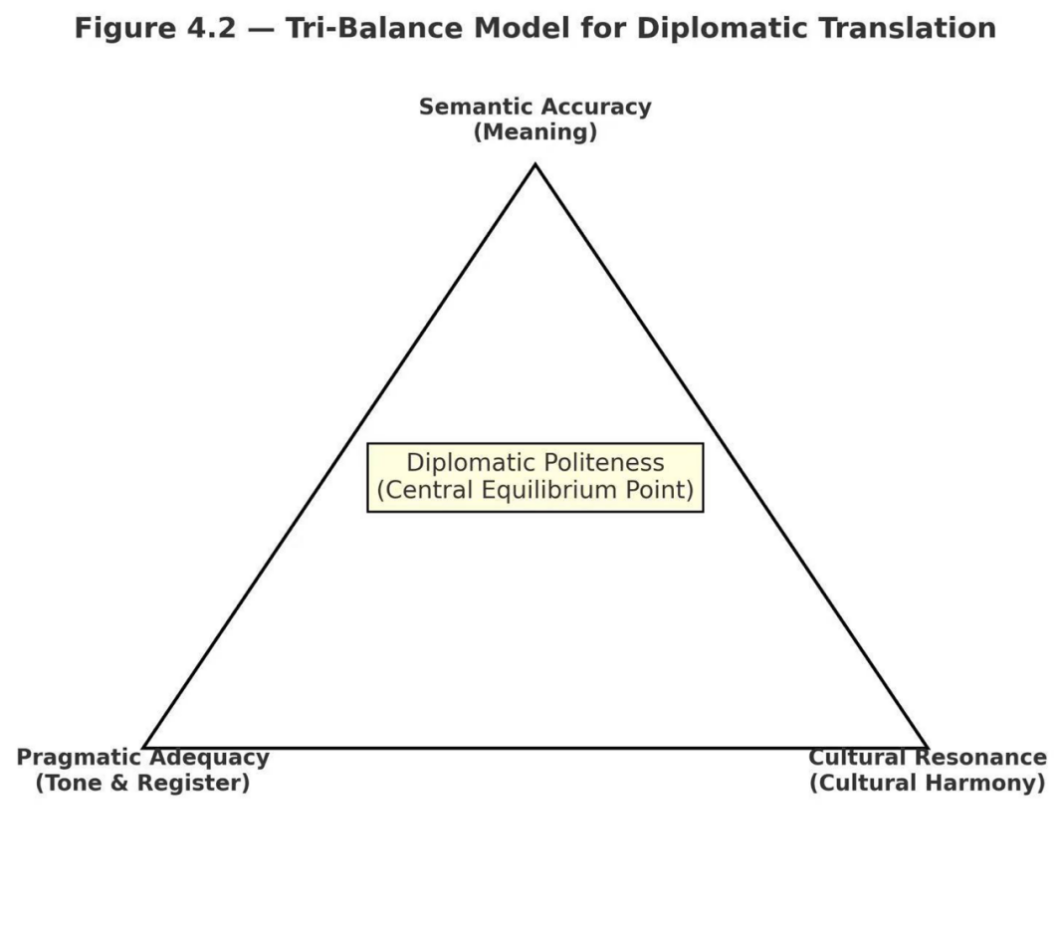
The illustration in Figure 3 represents the position of the diplomatic level of politeness as the focal center where semantic accuracy, pragmatic adequacy, and cultural resonance intersect. Effective translation aids in preserving this equilibrium-preserving meaning, tone and culture-preserving factual accuracy, as well as preservation of relational equilibrium. The next step of the Tri-Balance Model is transforming these theories into practice through linguistic techniques with which translators may support this balance. These strategies are a sort of compromise between literal and diplomatic translation that ensures a communicative charm and cultural awareness particularly in Chinese-English and Chinese-Russian translations when structural and ideological dissonance requires delicate change.
To illustrate the correlation among ethical, practical, and cultural elements, this paper will suggest introducing Ethical-Cultural Model of Diplomatic Translation (Figure 4). The model considers translator ethics as a dynamic moral system and the terms of Integrity (Loyalty and Accuracy) guarantee semantic integrity, Institutional Tone (Pragmatic Sensitivity) guarantees institutional tone and Relational Understanding (Cultural Empathy) enables relational understanding. Taken together, such dimensions are all oriented at the final goal of Intercultural Harmony which may be used as evidence of the effective use of diplomatic mediation.
Fig. 4. An Ethical-Cultural Framework of Diplomatic Translation
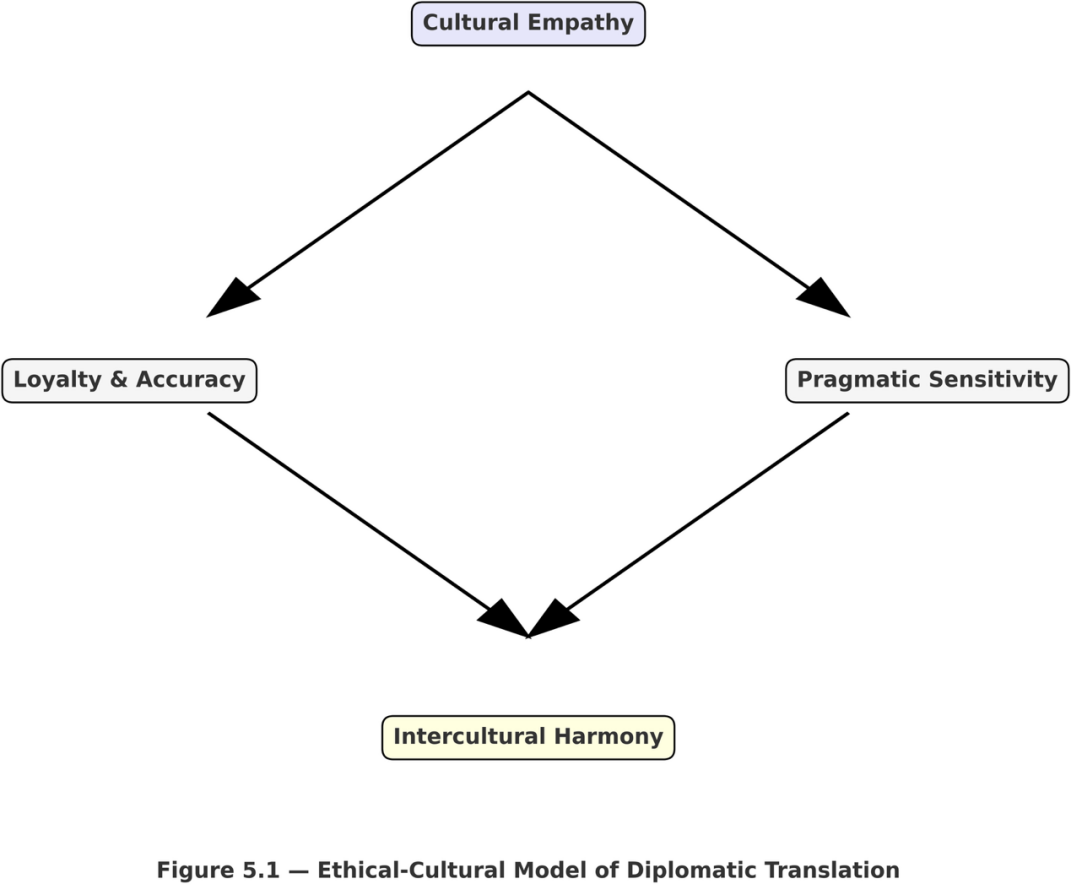
The model demonstrates that the ethics of translators in diplomacy do not have prescriptions but are situational. The balance between accuracy, sensitivity, and empathy will allow recreating the meaning without violating the moral balance. In practice it means that ethical translation is both a technical science as well as an act of intercultural diplomacy, and text integrity goes hand in hand with humanistic cognition.
The current research has implications that extend outside the theoretical framework and influence translator training and institutional behavior. Viewing diplomatic translation as an ethical-cultural mediation presupposes that translators should have at their disposal not only linguistic accuracy but also cultural sympathy and practice awareness [Kelly, 2005; Schäffner, 2004, p.117]. The older models focusing on the textual fidelity do not have what it takes to address the relational complexity of diplomacy. Pedagogy must accordingly embrace He-he cultural literacy-harmony, empathy and reciprocity- using real life material such as MFA communiqués and summit pronouncements.
This paper shows that politeness in Chinese diplomatic discourse is a multifaceted linguistic and cultural phenomenon rooted in the traditional ethical principles of the country. Review of official speeches, press reports, and communiqués shows that Chinese politeness may also be seen as an instrument of negotiation and as a moral discourse, which conveys harmony, respect, and empathy. Institutional power balanced by interpersonal skill, clarity balanced by relationship sensitivity. The authors point out that linguistic cultural sciences, and they write, the national-cultural stereotypes are reflected in the language, and they are closely linked to the lexical system and cannot be represented without this system [Daulet et al., 2019-3, p. 875]. In this situation, examples of politeness in Chinese diplomatic discourse should be understood not just as a collection of speech tricks, but as a picture of culturally-conditioned patterns of behaviour and attitudes and values that form communicative expectations. The concepts of face intact, modal forms and formulae operate as linguistic devices that support cooperative modes of intercultural communication. Cross-language comparison reveals that many of these politeness mechanisms do not have exact equivalents in English or Russian. Literal translational equivalence tends to create pragmalinguistic deficit in emotionally neutral or ambiguous Chinese writings. Then, translators have to use active methods of reformulation, tone-shifting, and contextualization to achieve the linguistic correctiveness and personal balance required in Chinese diplomatic communication. Such findings are similar to the general understanding that cultural codes mirror and describe the worldview and mentality of people groups [Daulet et al., 2018, p.583], a fact that is illustrated in the diplomatic discourse between Chinese and Russian and English linguo-cultures, where the culturally-driven standards of communication affect the rhetorical choices, interaction styles and the creation of diplomatic meaning.
The nature of diplomatic translation is not merely literal transferring of the content but mediates the cultural worldview and pragmatic intent of the source into the norms of the target language. It requires being sensitive to hierarchy, genre, and implied meaning. As it is a form of cultural re-encoding, it sets national image and communicative tone. It is then cultural and practical in terms of politeness, which indicates harmony, reciprocity, and relational ethics in Chinese diplomacy. The main results of the presented research are based on the structural, cultural, linguistic, and pragmatic factors of the politeness in the sphere of Chinese diplomacy:
-
Structure of organization: The Chinese diplomatic politeness is divided into three degrees that include ritual level, interpersonal level and institutional level to ensure decorum, empathy and strategy harmony.
-
Cultural Foundation: It is based on mianzi, qing and he-he, and it places a high value on self-control, respect and balance of communication.
-
The use of modality, euphemism and cooperative predicates is used in order to be polite because it can increase the level of agreement and cohesion between people.
-
Cross-Linguistic Trends: Translation is a process in which English likes clarity and less sentiment, whereas Russian retains group formalism as a result of pragmatic conventions not errors.
-
Realistic Changes: The losses may involve reduced empathy and moral values that will be brought back by means of sufficient recovery and this can be done via contextual restatement and impartial tone.
-
A successful diplomatic translator is distinguished by the ability to maintain a balance among semantic accuracy, pragmatic intent, and cultural resonance.
-
Value used: The findings can be considered as a model in terms of the training of translators and policy formulation with the emphasis on cultural literacy and pragmatics awareness as part of the he-he culture.
-
Restrictions and Viewpoint: Corpus size and interpretative bias remain constraints and there is a need to research in a multilateral context using both corpus based and experimental methods.
Conclusively, Chinese diplomatic politeness is an ethical harmony and intercultural legitimation, which has self-control, compassion, and teamwork all combined into one communicative ideal. Translation implies not mechanical transfer, but negotiation of its values and tone in a practical way, which reflects the soft-power nature of Chinese diplomacy. The results indicate that successful translation means striking a balance between textual fidelity and cultural empathy, helping to build an understanding of the role of linguistic choices in shaping the view of China in the world and offering sensible recommendations to translators and diplomats. This paper can be used as a reference in interpreter training in diplomatic contexts. Further studies can be conducted to widen the comparative analysis, and apply the tools offered by AI and corpora to investigate the change in style and adaptation of styles in multilingual diplomacy.
Примечания
- Ministry of Foreign Affairs of the People’s Republic of China. Joint Statement between the People’s Republic of China and the Republic of Kazakhstan on Further Deepening the Permanent Comprehensive Strategic Partnership.Beijing: Ministry of Foreign Affairs of the PRC, 17 October 2023. https://www.fmprc.gov.cn/mfa_eng/zxxx_662805/202310/t20231017_11168514.html (Accessed 3 Nov 2025). ↩
- Ministry of Foreign Affairs of the People’s Republic of China. Joint Statement on Regional Cooperation. Beijing: Ministry of Foreign Affairs of the PRC, 17 September 2021. https://www.fmprc.gov.cn/mfa_eng/zxxx_662805/202109/t20210917_9566674.html (Accessed 3 Nov 2025). ↩