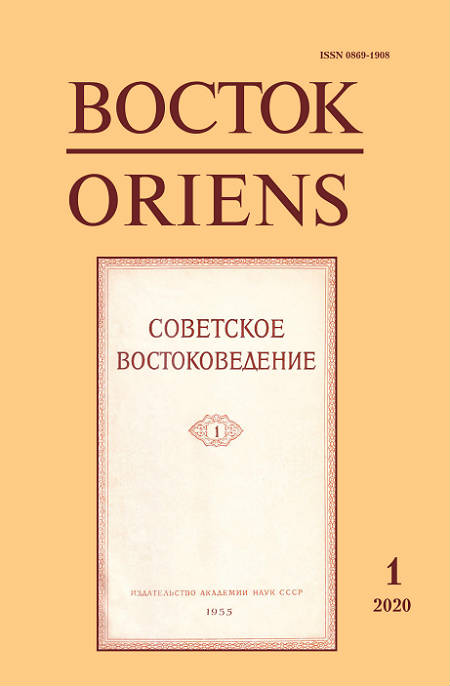



СТАТЬИ
   
     
ДРЕВНИЙ ВОСТОК


  • А.В. МИРОНОВА  “Прекрасный праздник Опет” – аналог царского хеб-седа?
   
     
ИСТОРИЧЕСКИЙ ИСТОЧНИК


  • Д.Е. МИШИН  Поход императора Юлиана Отступника на Персию (363 г.)
   
     
ЭТНОС И РЕЛИГИЯ
   
     
  • Б.Е. РАШКОВСКИЙ  Хазария: проблема выбора конфессиональной ориентации
   
     
РЕЛИГИЯ И ОБЩЕСТВО
   
     
  • Л.Н. МОРЕВ  Христианство и буддизм в Лаосе
   
     
ПОЛИТИЧЕСКИЙ ПОРТРЕТ
   
     
  • Б.Г. СЕЙРАНЯН  Мустафа Камиль: у истоков египетского национального движения
  • С.В. МАЗОВ  “Царство” Кваме Нкрумы
   
     
ИСЛАМ В РОССИИ
   
     
  • А.Р. НАВРУЗОВ (Махачкала)  “Джаридат Дагестан” (1913–1918): первая газета мусульман Кавказа на арабском языке
   
     
ЯЗЫК И КУЛЬТУРА
   
     
  • М.В. ПОРХОМОВСКИЙ  Языковая картина мира в зеркале турецких паремий
   
     
ВОСТОЧНАЯ ПОЛИТИЯ
   
     
  • М.О. КУЛИКОВА  Традиционная политическая культура и ре-формы в Индонезии
  • В.Ф. УРЛЯПОВ  Спецслужбы Индонезии
   
     
ТЕНДЕНЦИИ МИРОВОГО РАЗВИТИЯ
   
     
  • В.Н. УЛЯХИН  Мировой продовольственный кризис и страны Востока
   
     
СООБЩЕНИЯ
   
     
ЛИТЕРАТУРА И ИСТОРИЯ
   
     
  • А.Л. ФЕДОРИН  Хронологическая информация во вьетнамских летописях
   
     
ТРАДИЦИИ И РЕЛИГИЯ
   
     
  • Л.М. КОРОТЕЦКАЯ  Три колесницы Будды: разные пути к Пробуждению
   
     
ПОЭЗИЯ НА ВОСТОКЕ
   
     
  • Д.В. МИКУЛЬСКИЙ  Алжирская народная поэма Хизиййа – основное содержание и среда функционирования
   
     
ВОСТОК НА ЗАПАДЕ
   
     
  • А.Р. АЮПОВА  Афро-азиатские диаспоры Великобритании до 1980-х гг.: исторические предпосылки образования
   
     
НАУЧНАЯ ЖИЗНЬ
   
     
КОНГРЕССЫ, КОНФЕРЕНЦИИ, СИМПОЗИУМЫ
   
     
  • А.А. СТОЛЯРОВ  Третья международная конференция по дистан-ционному сбору данных в археологии
  • М.В. КОРОЛЬКОВ   Рождение империи: возвращение в царство Цинь
  • А.В. ДЕМЧЕНКО, И.П. ИВАНОВА, Д.Е. МИШИН   VII конференция арабистов ИВ РАН
  • Н.Н. ДЬЯКОВ   Изучение арабского мира в университетах Запада
   
     
НАУЧНЫЕ ЦЕНТРЫ, МУЗЕИ, БИБЛИОТЕКИ
   
     
  • С.В. ЛАПТЕВ  Сокровища Юго-Восточной Азии и Южного Китая в коллекциях Музея Миха
   
     
КРИТИКА И БИБЛИОГРАФИЯ
   
     
ОБЗОР
   
     
  • Е.А. БРАГИНА  ЮАР в оценках международных организаций
  • Д.М. КУЗНЕЦОВ  Источники и историография по теме “Роль храмов в жизни Северной Индии в раннее средневековье (IV–XIII вв.) по данным санскритской эпиграфики
   
     
РЕЦЕНЗИИ
   
     
  • В.И. ГОЛОВАЧЁВ  Духовная культура Китая. Энциклопедия в 5 и томах. Т. I–IV
  • Е.С. ГАЛКИНА, А.М. РОДРИГЕС  Очерки истории исламской цивилизации. В 2 х томах
  • В.И. ГУСАРОВ  А.В. Рясов.Политическая концепция М. Каддафи в спектре “левых взглядов”
  • М.Ю. РОЩИН  Daghestan and the World of Islam
  • Т.И. ВИНОГРАДОВА (Санкт-Петербург)  Wang Di. The Teahouse. Small Business, Every-day, Culture, and Public Politics in Chendu, 1900–1950
  • А.О. ЗАХАРОВ  O’Reilly D.J.W. Early civilizations of Southeast Asia
   
     
PERSONALIA
   
     
ЗНАМЕНАТЕЛЬНЫЕ ДАТЫ
   
     
  •   К 80-тилетию Л.И. Медведко
   
     
IN MEMORIAM
   
     
  •   Валерий Исаевич Рудой (1940–2009)
   
     
ОТКЛИКИ, РЕПЛИКИ, ПОЛЕМИКА ПИСЬМО В РЕДАКЦИЮ
   
     
  • О.В. ЗОТОВ   О закулисной дипломатической “революции” 1907 г.: предыстория и подоплека Антанты
   
     
SUMMARIES OF MAJOR ARTICLES


A.V. Mironova. “The Beautiful Festival of Opet” – is it the Analogue of the Royal Heb-Sed?

This paper is devoted to the problem of interrelation between Opet festival and the Heb-Sed of Hatshepsut and Thutmose III. The author points out the three main motifs of Heb-Sed in the scenes of Opet, represented on the walls of Hatshepsut’s Red Chapel at Karnak and her temple at Deir el Bahari: the Heb-Sed statues of kings, the ritual Running of the Course with Apis bull and the consecration of obelisks. The presence of such episodes in the Opet program has allowed us to propose that the formation of this festival took place by the time of Hatshepsut’s Sed-festival, thet was celebrated during her 16 regnal year. The analysis of decoration of Thutmose III’s buildings at Karnak (the Festival Hall of the Akh-menu temple, the wall of the Annals etc.) shows that Hatshepsut’s successor had preserved the Heb-Sed rituals in Opet festival and reinforced their connection with the military victories of the pharaoh.

D. Mishin. The Campaign by Emperor Julian the Apostate Against Persia (363)

This article is a study of different historiographical traditions related to the campaign against Persia by Emperor Julian of Rome (363). The “western” tradition was essentially based upon memories of those who participated in the campaign, which makes it the most reliable one, yet the presentation of facts depended on whether the writer was heathen or Christian. In the former case the text tended to be in favour of Julian, whereas in the latter he was put to blame. Besides that, there was a Syriac Christian tradition which had something in common with the Christian tradition of the West, but seems to rely upon stories told by those who merely heard about the campaign without being involved in it. Due to that, the Syriac tradition included a number of stories not confirmed by first-hand evidence. Later on, the Syriac tradition passed to Muslim historians, who combined it with stories of the Arabs’ fight against Iran in the 4 century. Finally, there was a Persian tradition, of an entirely legendary nature, which applied a story of an earlier triumph over the Romans to the struggle against Emperor Julian.

B.E. Rashkovskiy. Khazaria in a Search of Confessional Identity

The paper is consecrated to a problem of influences of different neighboring peoples and cultures on the development of Khazar state. The religious changes in Khazaria are in focus of author’s attention. Author attempts to trace what were the main factors, that were leading to the religious changes in this so-called Steppes-Empire starting from strong Byzantine Christian influences from the West, conversion of ruling elite into Judaism before 830s and final Islamization in the middle of the 10 century. Author also deals with the problem of the placement of Judaic population in Khazar khaganate and neighboring territories. According to his supposition the Crimean peninsula and Bosporus could be the places, where the Jewish presence is can be verified both by written archeological sources. The historiographic problems of (re)constructing “Khazar Judaism” are also discussed in the paper.

L.M.Morev. Christianity and Buddhism in Laos

Buddhism was proclaimemd the official reliof the Laos state in the middle of the XIV century and kept this sttus ur to 1975 being under the guardinship of all ruling monarchs and authorities. Christianity, a new religion for this country, that penetrated there only about one hundred years ago, which has only one and a half hundred thousand follofwerrs, is represented by the Roman cathnolic chuchh and different Protestant democrations. At present the most complex subjeets in the relogious field of Laos have proved to be not numerous Protestant congregations belonging to a number of seets. They insist on the right of spreading their dogma and are involded in activa preaching, first an all, awong the pagan part of the Laos population to attract it to thdmslesves and to use in for political purposes when nessary. Thus there develops an opposition of this form of Cgristianity to Budddism thar till now has held a mo0nopoly it the spiritual life of Laos; it is fraught with a discord and conflicts it the Laos society.

B.G. Seyranyan. The Origin of the Egyptian National Movement: Mustafa Kamil

Not a single persentative of the Egyptian political elity of the end of the XIX – the beginning of the XX centurien has had such a strong and profound influence on the development of the social thought and liberation movement of his country as Mustafa Kamil. An outstanding publicist and a fiery orator – “a tribune of Egypt”, the entered history as the foundler of the ideology of Egyptian nationalism and the leader of the struggle for independence. During 15 years till his early death he was a dominant year after Kamil”s death in 1979 his famous poem “My country, my country” put to mucis by prominent composer Sayyid Davich and later orcestrated by Mukhammad Abd al-Vakhab has a repubblical decree become the state hymn of the Arab Rebublic of Egypt.

S.V. Mazov. “The Kingdom” of Kwame Nkruman

It had fallen to Kwame Nkruman’s lot to experience brilliant victories and enjoying absolute power, a sudden failure and the betrayal of his comrades-in-arms, a forced emigration and an agonizing reappraisal of values. In his life monuments were erected to him and then pulled down, he was deified and the anathematized. “The father of the nation” died in emigration, but he was buried in his native country as a national hero. The interest in the personality of Nkruman does not become weaker. The appraisal of his deeds and ideas are contradictory, sometimes polar opposites: “a communist”, “a nationalist”, “a romantic”, “an idealist”, “a Pragmatists”, “a messiah”, “a dictator”, “a tyrant”.

A.R. Navruzov. “Jaridat Daghistan” (1913–1918): The First Arabic-Language Periodical for Caucasus Muslims

The weekly four-strip public political newspaper in the Arabic language was been published from January, 7, 1913 till 1919 at the publishing house of M. Mavrayev in Temir-Khan-Shura of the Daghestan province (now Buynaksk town in the Daghestan Republic). The official editor of the newspaper was Badavi Saidov (1877–1927), the chief of the Clerical Office of the military Governor of the Daghestan province. In fact all the work in preparing and publishing the newspaper was done by Ali Kajayev (1878–1943). The third person who played an important role in “Djaridat Daghistan” publishing was Muhammad-Mirza Mavrayev (1878–1964), because the newspaper was printed in his publishing house. This newspaper was spreading not only among village courts in Daghestan, but also among numerous readers of Daghestan, Chechnya, Cherkesia, Kuban and Stavropol regions, Turkestan and Azerbajgan.

There were different headings of the newspaper: official, non-official, literary, advertisement, letters and also the scientific heading. The latter heading was the most interesting for readers. The newspaper is the source for researching the history and culture of Dagestan and North Caucasus.

M.V. Porkhomovskiy. Linguistic World Image in the Mirror of Turkish Proverbs

The vocabulary of Turkish proverbs has not been an object of special analysis. We only may note a few publications by Turkish scholars, dedicated to the analysis of certain words that are used in the proverbs. The article presents certain results of the statistical analysis of the vocabulary of more than five thousands Turkish proverbs. The analysis gives a better understanding of the linguistic world image of the Turkish people as well as of Turkic peoples in general. Similar studies of other peoples’ proverbs will lead to the comparative analysis of the linguistic world image in the mirror of folklore.

M.O. Kulikova. The Traditional Political Culture and Reforms in Indonesia

The specific character of political processes in modern Indonesia is to a considerable degree caused by the many centuries of its historical and cultural past. The latter’s main component are the political culture of Indonesia and the subcultures of the peoples living in the country, mainly that of the Javanians, who are the dominating nationality. The main historical stages of formation and development of Indonesia’s political system are of special interest in the light of the Indonesia’s traditional views on power.

V.F. Urlyapov. Indonesia’s Special Servives

Besides the armed forces and the police, the intelligence agencies constituted the third pillar of Indonesia’s security apparatus. Under Suharto, the intelligence function resided in a plethora of organizations, the most important of which were the Strategic Intelligence Agency (BAIS), responsible for military and foreign intelligence, and the State Intelligence Coordinating Board (BAKIN), predestinated the State Intelligence Agency (BIN), after the fall of Suharto. In the latter Suharto years, BAIS and BAKIN personal also staffed the Agency for the Coordination of Support for National Stability Development (BAKORSTRANAS), headed by the armed forces commander, which kept track of any political threats to the regime. After Suharto’s downfall, BAKORSTRANAS was disbanded and the lines of authority in the intelligence community, which in Suharto’s New Order regime converged in the person of the president, were thrown into disarray.

V.N. Ulyakhin. Global Crisis in Developing Countries of Asia

Systemic causes for increases in food process are the subject of this article. Long-term causes remain a topic of debate. These may include structural changes in trade and agricultural production, increasing befoul usage, growing consumer demand in Asia, agricultural price supports and subsidies in developed nations, an increasing demand for a more varied diet of the expanding middle-class of Asia, diversions of food commodes to fuel, food market speculations and climate change, As of 2009, food prices have fallen from their earlier hights, but this decrease may be temporary.

One systematic cause for the price rise is held to be the diversion of food crops (maize in particular) for making biofuels. An estimated 100 million tons of grain per year are being redirected from food to fuel. Additionally, agricultural production is also lost due to water depletion. Urbanization is another cause of annual cropland reduction. The author also pinpoints those socio-structural forms which have turned into a brake for transformations in agriculture within the framework of industrial technological processes. The socio-economic structure which was necessary during the stage of extensive industrial growth becomes unadaptable to the innovations under postindustrial conditions.

Judging from the experience of the developing Asian countries, there does not exist a way for implementing technological progress in agriculture divorces from the global trends. It is dynamics of the employment content and postindustrial structure that determines the rates and scale of increasing food production.

A.L. Fedorin. The Chronological Information in Vietnamese Chronicles

In the far eastern tradition of writing chronicles chronology has always played one of the key roles being used as “concealed instructions”, a way to show, though not explicitly, the authors’ attitude towards certain events or people. In this respect Vietnam is not an exception. The strict chronological system in the Vietnamese chronicles was developed by Ngo-Shi-Lien the XV century. In the XVIII century Ngo-Shi-Lien made attempts to change some of its postulates, but in general the ideas of Ngo-Tshi-Shi dominate both in the traditional and contemporary chronology. This can be accounted for by the fact that they are based on radical patriotism, which is still in need up to the present moment. In the article the author, using particular examples, shows the peculiarities of the Vietnamese chronicles of different periods, as far as designing headings and stating time periods in the chronicles’ articles, determining the periods of ruling of certain emperors and describing the periods of change of government mottos and temple names of the Vietnamese emperors are concerned.

L.Korotetskaya. The Three Chariots of Buddha

The paper presents the description of the Three Chariots of Buddha - three ways of a spiritual development (The Small Way, The Great Way, The Diamond Way) which keep and pass on the different philosophical points of views and methods of the achievement of Liberation and Enlightenment.

The Three consecutive levels of Teaching kept by a historic Buddha Shakhyamuni – The Small Chariot, The Great Chariot and the Diamond Chariot are correlated by the author with the Three Turnings of Dharma’s Wheel.

An accurate interpretation of the Buddhist terms helps us to understand their attitude to different levels of Buddha’s Teaching, improves the efficiency of philosophical investigations and helps to comprehend a specific character of different Buddhist philosophical schools.

D.V. Mikulsky. The Algerian Folk Poetry Khiziyyia: the Main Content and the Milien of Functioning

This report is devoted to a work of the Algerian folk poetry written in a special poetic language (malkhun). Such poetry has ancient and deep traditions in Algeria. The author thinks that of interest are not only the history and the poetic merits of the poem, but also how he has got this work. A story about it has its own ethnographic interest.

A.R. Ayupova. Muslim Afro-Asian Diasporas in Great Britain: Historical Preconditions of their Formations

This article is devoted to revealing the historical preconditions of the formation of a Muslim Afro-Asian diasporas in Great Britain. Contrary to stereotypical and popular perceptions of Muslims as a monolithic group, one of the most striking aspects of Muslims living in Britain today is their diversity. This is clearly reflected in the wide range of ethnic backgrounds that they encompass, and is directly related to the fact that Muslim migration to Britain from many different parts of the world has been an important feature of the last 150 years.

Chronological frameworks of the article cover the period from the mid-nineteenth century (because the first relatively permanent Muslim populations were established in Cardiff, Liverpool, Manchester, South Shields) to the present moment.

The colonial past of the empire in many respects has defined ethnic structure of the muslim community. Process of disintegration of the British colonial empire has led to substantial growth of immigration flows.

Since the Second World War, Muslims have migrated to Britain in relatively much larger numbers, with the majority coming from South Asia (primarily Pakistan and Bangladesh). In addition, smaller Muslim communities from a variety of regions, including parts of Africa, Malaysia, the Middle East and, more recently, Eastern Europe (primarily Bosnia), have also settled in Britain.

The processes which directly affected structure, volume and ethnocultural variety of Muslim Afro-Asian diasporas of the country, are included into a problematic of the article.


  • Публикуемые материалы не обязательно отражают точки зрения Института востоковедения и Института Африки РАН, а также редколлегии и редакции журнала.


© Российская академия наук. © Редколегия журнала "Восток/Oriens"(составитель).